Sunday, June 17, 2018

Tuesday, May 8, 2018
Sabbatical: River of Life
Rivers as the source of life is not something I came up with myself. It is a theme that God presents throughout the entire Bible, from beginning to end. Check this out! This is why I am so looking forward to going on this Sabbatical in 3 weeks.
Sabbatical: Sabbatical Route
For all you navigators and geography buffs, here is a little info about the route we will be taking for our Sabbatical.
Thursday, March 1, 2018
Sabbatical: What is it?
Hi friends, Laura, Jess, and I are planning a sabbatical for this summer. I would like to share this experience with you by way of a video blog or vlog. I will let you know right from the beginning that this is way out of my comfort zone, being the introvert that I am. However, part of the reason to have a sabbatical is to find new ways to connect with God, family and friends. So...here we go. I hope you enjoy it and please share any thoughts with me as we go on this amazing adventure. Thanks.
Thursday, January 4, 2018
December 27, 2017
My daughter Leslie turns 30 years old today. That right, 30 years ago today I took Laura
to the hospital in San Salvador, El Salvador.
That, in and of itself, was an act of faith for me. The delivery was pretty normal except for the
fact that the doctor who was going to do the delivery was smoking a cigarette
in the delivery room as he was about to examine Laura. And the other thing was that the doctor did not
want me in the delivery room; but I refused to leave…who knows, he might have
lit up again at any time!
Leslie came
into the world in the normal way and our first daughter was a true prize. I began to dream about her future and when I
did I could not get out of my mind a beautiful girl riding a horse with a long
blond ponytail. I still have that dream
of Leslie, only it will not come true in this life. Leslie developed seizures when she was just
two months old. We did not think
anything of it first and neither did the neurologist we took her to in El
Salvador. We went to Costa Rica and had
an electroencephalogram (EEG) done on her.
Three doctors looked at it and two said it was fine and one said there
might be a problem. We still were not
satisfied. Laura and Leslie went to
Tulane Medical Center where my cousin, who taught at the medical school there,
referred us to a pediatric neurologist.

The
results were not what we wanted to hear. Leslie had a seizure disorder and we needed to
stop the seizures which were damaging her brain. Well, 30 years later, we have still not
controlled the seizures. However, Leslie’s
health has been a controlling factor in our lives. We have bought a house, purchased vans,
determined vacations (or lack of them), changed jobs, changed career goals, and
simply tried to change the future to be the best parents we could be for our dear
Leslie. It has all been worth it.
Raising Leslie has been one of the most profound things that has ever happened
to us.
I am
about to embark on a study of the book of Job at Trinity Church where I am the
pastor. I have been reading, wrestling,
praying, and crying about suffering over the past couple of weeks. Though God never created the world with
suffering in it, I am finding that it is only through suffering that we learn
to love God. What a paradox. God allows suffering to come into our life, which
in turn teaches us to love him more. Now
this is not the regular response to suffering.
Often we turn in on ourselves and think that we must deserve whatever is
happening to us. Not true. And just as often we turn on God and tell him
he is not fair and we did not deserve whatever we are passing through. Also not true.
But
instead of blaming self or God, we simply need to find the source of our life
and happiness not in our health, possessions or family, but only in God. And when we find God as the source of everything,
then nothing can take our happiness or our life away from us. Ultimately, suffering teaches us what really
matters in life and in death. And once
we have learned that, our joy is secure in all circumstances. That is the best thing we can learn in life
-- too bad it often takes several bouts with suffering for us to begin to
understand this. But once we know and
experience the potential of suffering, life becomes the joy that God wants it
to be.
Wednesday, December 6, 2017
Rivers Bring Life
The Father, Son and Holy Spirit created life. And then, they began to spread life
everywhere. God the Father created the
heavens and the earth. He did so through
God the Son, as the book of Colossians says: “For by him (Jesus Christ) all
things were created: things in heaven and on earth.” But the Holy Spirit is also active in the
creation of the world, as Genesis tells us when it says, “and the Spirit of God
was hovering over the waters.” The
Triune God loves life, and let me tell you, I do too! And I just love the way that this Triune God
bring us life.

The focus of waters right from the beginning gives us an indication of the way that God was going to use water as that which brings us life. Genesis 2:10-14 says, “A river watering the garden flowed from Eden; from there it was separated into four headwaters. The name of the first is the Pishon; it winds through the entire land of Havilah, where there is gold. (The gold of that land is good; aromatic resin and onyx are also there.) The name of the second river is the Gihon; it winds through the entire land of Cush. The name of the third river is the Tigris; it runs along the east side of Ashur. And the fourth river is the Euphrates.”
The river flowing from Eden gives life to all that God has
created. The river separates into four
headwaters which signify the four corners of the world as the ancients
understood it. God simply used four
rivers to bring life to the entire creation.
From the beginning, water was life.
And water is best delivered by way of a river.
Later, in a seemingly hopeless time for God’s people, the
prophet Ezekiel was given a vision of a river flowing from the altar in the
Temple. Though it started very small it was
soon a great river with many trees growing on the banks. The river flowed into the Salt Sea and there
everything turned sweet with swarms of living creatures everywhere. People were fishing on the banks of what once
was a barren body of water. This is a
great picture of a river giving life to flora, fauna and folks everywhere. Don’t we just long for the vision of Ezekiel
to become a reality in our lives?
Ezekiel’s vision is repeated in the last book of the
Bible. In the last chapter of Revelation,
when heaven has come down to earth and eternity is about to begin, we see a
river of the water of life flowing from the throne of God. As it flows there are trees that line the
river producing fruit every month of the year.
The leaves of those trees are for healing the brokenness of the
world. So once again, as in the
beginning, the river is the way that God brings life to the New Heavens and the
New Earth.
Right in the middle of these beautiful images of rivers giving life to all God has created, Jesus takes this image several notches higher. In John 7:37-39 it says, “On the last and greatest day of the festival, Jesus stood and said in a loud voice, ‘Let anyone who is thirsty come to me and drink. Whoever believes in me, as Scripture has said, rivers of living water will flow from within them.’ By this he meant the Spirit, whom those who believed in him were later to receive. Up to that time the Spirit had not been given, since Jesus had not yet been glorified.” Jesus is the ultimate life giver, but with this unbelievable promise he tells us that all who drink of him will become rivers of life-giving water. Imagine that; out of me and you there will be a river of life wherever we go!
I so want that to be true of me. I long to be a river of life flowing all over
the place, giving life to whomever wades into my waters. This is also why I find caring for rivers and
streams so very important, especially in the context of a church ministry. Rivers bring life to all the creation. The church is called to bring life to all
creation. And when we can combine the
two in a visible way that helps the world see how much we value bringing life
to creation, that is truly a beautiful thing, and something that gets the
attention and appreciation of our community.
Rivers are essential for our environment so we need to care
for them. It does not matter if they are
the mighty Mississippi or little Rush Creek.
But whether we are restoring badly degraded waterways or simply appreciating
the life they give, each one of us is called to be a river of life spreading
God’s life in some way wherever we go.
Are we doing it?
Tuesday, August 22, 2017
Church on Mission

I think
there are a couple of reasons for this.
First of all, I think we have all grown up in a church where mission is
seen as something only done in another context and by other people. This false understanding that mission is
something done “overseas” has been very detrimental to the church. When we think of the church primarily as a place for the
care and fellowship of the saints or the members, we have lost the biblical
understanding of what the church really is.
Jesus Christ did not die for a club but for a church, which was left
here on earth to carry out the mission which he began: to seek and to save the
lost EVERYWHERE. There are people who
need Jesus all around us. More than half
of the people who live in Georgetown Township do not attend church. Many of them were once members of a church
but came to resent the church or see it as irrelevant. Additionally, God has brought many refugees
into our community and this is a tremendous opportunity to be on mission for
Jesus.
The
second reason why the church today is not on mission is that we simply do not
know how. For many established suburban CRC churches the only
prerequisite to growing has been
to have a nice building, a halfway decent preacher and a very good
organist. There was never any need, and
perhaps not much concern, about reaching the lost. In fact, if churches in the suburbs wanted to
reach the lost they would start at “chapel” and the new believers could go
there, but not to our churches.
Today this is still what draws
people to church:
beautiful and useful buildings, strong preaching, excellent music programs and
exciting kid/youth programs. But this
still does not mean that a church has a mission other than to collect people
from other churches that are already believers.
What is really rare today is a church on mission, where the people attending are there because of their love and calling into the
mission of Christ to save the
lost.
The
movement that is needed to enter into the mission of Christ is one which
requires us to submit all of our own desires to His and all of our own personal
missions to His mission. It means singing with sincerity the hymn, “Take my
life and let it be, consecrated Lord to thee…Take my silver and my gold, not a
mite would I withhold. Take my intellect and use every pow’r as Thou shalt
choose…Take myself and I will be ever, only, all for Thee.” When we understand the sacrifice that is
required to be on mission with Christ, we will be able to do some amazing
things for Him because of Him.
Being a
man or woman or boy or girl on a mission is really the only way to live. This is why Christ created us and redeemed us
in the first place. And when we are on
mission with Christ, we are living the live we have been given to live. It simply does not get any better than that.
On
a personal note to the church I pastor, I would like to emphasize that I believe that this is the time, today
is the day, that Trinity CRC must strengthen its resolve to be the church we
are called to be, a church that marches forward with confidence on a
gospel-proclaiming, world- redeeming mission.
And we are in a position to do this, God helping us, as we keep our
mission aligned with his mission. We
need to be a body of grace-embracing, love-motivated, Spirit-filled people who
can put aside some previous notions of the role of the church and of the place
of missions and follow the command of Christ to follow God on his mission to
redeem and restore the world, near and far, wherever that takes us. I hope this describes each one of us, and I
invite you to a great adventure of mission with Trinity CRC.
Tuesday, October 4, 2016
Diverse Leadership in the Early Church
The level of racial tension in the U.S. right now is very
high. And I am afraid that even
Christians have not become immune to this deadly virus. We can so easily respond by cocooning in our
own ethnic environment. But this is
certainly not the Lord’s will and destructive to our mission and calling
in the world. The Lord has taught us how
very important collaboration is between different ethnic groups by revealing to
us the ethnic make-up of the leadership in the church in Antioch. The disciples were very intentional about
keeping a multi-ethnic church together in the face of Jew and Gentile tensions.
They were not willing to let each ethnic
group start their own separate church. If you look at the leadership of the church in
Antioch you will see the face, or faces, of integration.
Acts 13:1 says, “In the church at Antioch there were
prophets and teachers: Barnabas, Simeon called Niger, Lucius of Cyrene, Manaen
(who had been brought up with Herod the tetrarch) and Saul.” The names that are given here actually tell
us a lot about the people who formed the leadership and teaching team of the
church in Antioch.
 Barnabas is really quite well known. We are introduced to him in Acts 4:36,
37. His name was Joseph and he was a
Levite from Cyprus. The apostles called
him Barnabas which means “son of Encouragement,” or simply an encourager. Being from Cyprus we was a Hellenistic Jew
which meant his principle language was Greek and he was immersed in the Greek
culture. If I would put a face on
Barnabas it would be this one:
Barnabas is really quite well known. We are introduced to him in Acts 4:36,
37. His name was Joseph and he was a
Levite from Cyprus. The apostles called
him Barnabas which means “son of Encouragement,” or simply an encourager. Being from Cyprus we was a Hellenistic Jew
which meant his principle language was Greek and he was immersed in the Greek
culture. If I would put a face on
Barnabas it would be this one:  The next leader of the church mentioned in this passage is Simeon
called Niger. Because there were
probably other men named Simeon they distinguished him by calling him by a
Latin name, Niger, which means black.
Now to call somebody black in a location and place where most everybody
had a darker skin tone, probably means he had very dark complexion. So Niger was a black man most likely from
Africa. If I would put a face on Niger
he would look like the portrait to the left.
The next leader of the church mentioned in this passage is Simeon
called Niger. Because there were
probably other men named Simeon they distinguished him by calling him by a
Latin name, Niger, which means black.
Now to call somebody black in a location and place where most everybody
had a darker skin tone, probably means he had very dark complexion. So Niger was a black man most likely from
Africa. If I would put a face on Niger
he would look like the portrait to the left. The third person listed on the leadership council of the
church in Antioch is Lucius of Cyrene.
Once again the name Lucius was common in the Roman world so they added
where he was from in order to distinguish him.
He was from Cyrene. This is a
place in North Africa close to where Libya is today. Before the Arab invasion of North Africa in
the 600’s almost all of the inhabitants would be from African descent. So I think the picture to the right would look
at lot like Lucius:
The third person listed on the leadership council of the
church in Antioch is Lucius of Cyrene.
Once again the name Lucius was common in the Roman world so they added
where he was from in order to distinguish him.
He was from Cyrene. This is a
place in North Africa close to where Libya is today. Before the Arab invasion of North Africa in
the 600’s almost all of the inhabitants would be from African descent. So I think the picture to the right would look
at lot like Lucius: Next we read about Manaen.
The explanation that the text gives is that he “had been brought up with
Herod the Tetrarch.” Literally this
means that he shared the same wet nurse as Herod the Tetrarch. As was often the case in wealthy families,
mothers did not nurse their own children but got a servant to do that. In any case, Manaen was very close to a very
wealthy family and a close personal friend of Herod the Tetrarch, the person
who had John the Baptist beheaded. Yet
Manaen went down another path as God called him into leadership of the church
in Antioch. Manaen would have been ethnically
similar to the Palestinians today. He
might have looked like the picture on the left.
Next we read about Manaen.
The explanation that the text gives is that he “had been brought up with
Herod the Tetrarch.” Literally this
means that he shared the same wet nurse as Herod the Tetrarch. As was often the case in wealthy families,
mothers did not nurse their own children but got a servant to do that. In any case, Manaen was very close to a very
wealthy family and a close personal friend of Herod the Tetrarch, the person
who had John the Baptist beheaded. Yet
Manaen went down another path as God called him into leadership of the church
in Antioch. Manaen would have been ethnically
similar to the Palestinians today. He
might have looked like the picture on the left. Finally we come to Paul.
Paul was a Hebraic Jew, born in Tarsus and raised in Jerusalem under the
tutelage of Rabbi Gamaliel. Paul was a
Jew of Jews, being extremely well-versed in the teachings of the Law. I would imagine Paul looking something like
this:
Finally we come to Paul.
Paul was a Hebraic Jew, born in Tarsus and raised in Jerusalem under the
tutelage of Rabbi Gamaliel. Paul was a
Jew of Jews, being extremely well-versed in the teachings of the Law. I would imagine Paul looking something like
this:
Now, if you put these five faces together as the leadership
of the church in Antioch, you can see how diverse the leadership actually
was. But this diverse leadership was
exactly what was needed for a multiethnic church and a mission to all the
ethnic groups in the Roman Empire.
Jerusalem, on the other hand, was still largely Jewish in its outlook
and, in fact, sent envoys to Antioch trying to make them become more Jewish and
not simply be followers of Christ in their own ethnic way. I believe this is exactly why God used the
church in Antioch to be the missionary church to the entire world. You might
say that because of Antioch’s diversity, they were well equipped to be able to
bring the Gospel to a diverse world.
They were able to let Jews be Jews, Romans be Romans, Greeks be Greeks,
and Cyprians be Cyprians, all being transformed by the Spirit of Christ.
It is my strong belief that what the church of Jesus Christ needs
today are diverse congregations that, because of their diversity, are more
easily able to bring the Gospel to every nation, race and ethnic group in the
world. May God bless us with more and
more churches of diversity.
Thursday, September 1, 2016
Between an In-law and an Outlaw
I love camping. We
have a great tent, sleeping bags, and cooking equipment. But what I love the most is the opportunity
to find some solitude and be outdoors for several days at a time. Having grown up in a camping family, I have been
pleasantly surprised as my wife Laura’s family has gotten into camping. In fact, they now have a family camping trip
every summer in Vermont, where they are from.


This past summer we tried a new campground on a beautiful lake. We pulled into our campsite just after noon
on Thursday and got our tent, tarp and outdoor kitchen all set up. It was a great place under some majestic
white pine trees.

Later that afternoon Laura’s family began to set up camp
just to the south and west of our campsite.
Fifty-three of them arrived in all.
It was good to see her family again after about a year had elapsed. Interestingly, the campers to our east and
north started arriving about the same time.
First one Harley, then another, and another, and then some trucks until
there were about fifty-five members of the Devil’s Desciples (spelled wrong
intentionally) motorcycle club from Boston, MA, occupying the rest of the
campground. For four days our little
campsite was surrounded on one side by fifty-three in-laws, and on the other
side by fifty-five outlaws. In fact the
Devil’s Desciples consider themselves one of the 1% of motorcycle clubs that pride
themselves on not being so law abiding.
They did their share of drinking, fixing their Harleys, and smoking pot. In Vermont, possession of an ounce or less is
not a criminal offence and, I guess, once you smoke the first ounce you can
possess a second ounce…and so on.
Anyway, needless to say, we got to smell our share of second hand pot
smoke for four days.
Now you might think that being a tent sandwich between so
many in-laws and so many outlaws could ruin a vacation. We certainly did not plan this. However, our son Jesse resurrected the
weekend by showing hospitality to everybody all weekend long. He was very comfortable to be with his cousins
by our campfire and to be with the Devil’s Desciples at their picnic
table. In fact, he was so accepting of
the Devil’s Disciples, that when we were about to leave, they gave him an
honorary member’s t-shirt: a black T with an ugly white skull and bright red
letters saying, “Devil’s Desciples.”
There was no giving it back. They
even threw in a black neoprene beer cooler with the same skull on it to show
how much they loved Jesse’s hospitality.

I wish I could be so hospitable. Oh, maybe you could simply chalk it up as
being Jesse’s Down Syndrome that makes him so accepting of others. But if is it Down Syndrome, I think I would
like a little of it! I often ask, “How
can I be as attractive to and accepting of others as Jesus Christ was?” I think the first step is seeing people as
Jesus sees them, not as enemies, or outlaws, but people created in the image of
our Heavenly Father and for whom Jesus came to earth.
If the outlaws, or the in-laws for that matter, got a glimpse
of Jesus Christ that weekend, it was not through me, unfortunately, but through
my son, Jesse Ryan, a man after God’s own heart.
Thursday, April 23, 2015
The Big Bad Book
I can remember getting quite worried over what was going to
be revealed when I stood before the judgement seat of God and all the books
were opened and every sinful thing I had ever done would be read off for the
entire world to hear. I could only
think about how terrible this would be and I wished that I might be able to
skip out on this. I was often told that
you cannot skip out on this exercise, but that everybody had to go through
it. I thought about how embarrassing
this would be to have my mother, who I knew was going to be there, listen to
everything I had so carefully concealed from her. That was scary! In fact, the whole reason that eternity was
going to be eternal was to give enough time to read everybody’s list – that is
how long eternity will have to be. I am
sure it would take several weeks just to get through mine!
Lately I have been looking at the book of Revelation
anew. I came to that passage that says,
“And I saw the dead, great and small, standing before the throne, and the books
were opened.” Then it says that the dead were judged according to what they had
done as recorded in the books. I have
spent some time thinking about this.
Something that helped me understand this is an exercise called blackout poetry.
Blackout poetry is when a person takes a newspaper or a book
and, using just one page, blacks out all the words that they do not want to be
in the poem. The result is a poem
consisting of only the words that the person has left uncovered. I have a good idea that this might be what
will happen to everything that we have done wrong. It will be blacked out by the grace of
Christ. Or, you might say, that his
blood will completely “red” out the sin and leave only three simple words.
I decided I would try this.
So I got the book East of Eden,
by John Steinbeck. I took that book
because it really examines sin as it takes root in a family relationship,
something that happened after the fall of Adam and Eve when they were cast out
of the Garden of Eden to the east. Well this
is the blackout poem that I made from page 42 of the book East of Eden, and that I believe Jesus creates in our books:

Everything is gone except the most powerful three words in
the world: “I love you.” That made so
much sense to me. I recall the great
words from Psalm 103:12, “As far as the east is from the west, so far has he
removed our transgressions from us.”
Another beautiful passage that comes to mind which gives me such great
assurance is I Corinthians 13:5, which says that love “keeps no record of wrongs.” If the Lord is instructing us to demonstrate
this kind of love, you can be sure that he is modeling this kind of love for us
every day.
I have greater comfort now that when the books are opened at
the last judgment, what each of us who have found forgiveness in Christ will
see is a blackout poem with nothing but the wonderful words, “I love you,”
–Jesus.
Thursday, March 12, 2015
Palm Power
Hate begets hate;
violence begets violence; toughness begets a greater toughness. We must meet
the forces of hate with the power of love. Martin Luther King (1958)
We live in an ever-increasingly violent society. It seems that violence has a price tag and
people are making their living off violence.
From electronic video games and YouTube clips that display violence, to
the weather reporters who try to make every storm violent, and ultimately to
groups like ISIS who film terrible atrocities, we are surrounded by
violence. Even when you read the Bible
there are some times when you run into a great deal of violence. People are beheaded, taken as slaves, and
maimed. Children are mercilessly killed,
even sacrificed over the fire.
And then Jesus comes on the scene. In a world of darkness and violence, here
comes light and peace. He absolutely
refuses to fight fire with fire or violence with violence. When he was about to be pushed over a cliff
after his first sermon, he just walked away and never raised a fist. He encouraged his followers not to resist an
evil man; and even if somebody might require something from them, offer that
person more than their unreasonable request.
But the power of peace was fully realized when Jesus
defeated his longtime nemesis, Satan.
When Jesus was taken to the cross he did not resist for one minute. He was, as Isaiah says, a “Lamb led to the
slaughter.” At a time when anyone else
would have clenched his fists, Jesus opened his palms and let them drive the
nails through his hands. It was in this
most unexpected way that the most powerful dark force in the universe was
defeated. It was Palm Power which broke
the Devil and set the prisoner free. In
a day when we are told that the only way to defeat a bad man with a gun is to
find a good man with a bigger gun, I really wonder what Jesus would do. Perhaps we should reflect on our preferential
strategy of defeating evil with overwhelming force. Jesus defeated overwhelming evil with love.

As I
have been reading and studying the book of Revelation this winter I have often
thought about the amount of violence that is recorded there in the vision of
John. One thing I know is that since
Jesus has already defeated Satan with Palm Power, there is no reason for him to
have to now resort to violence to finish him off. It seems like an insult to the power of the
cross to say that Jesus could deal Satan a mortal blow by Palm Power, yet then
have to pick up a sword to finish him off.
What John sees in the book of Revelation is simply the rebellion of a
defeated foe. When all the power Satan
can muster faces off against Christ, Christ only has to show up and the evil
armies will simply crumble when he speaks the Word. Why would Christ, who called the world into
existence with his Word, have to use a sword to defend himself? It is beneath his dignity. The sword which comes from his mouth is
simply his Word, which is so powerful that he was able to call the stars into
existence and give life to man. He would
never use man’s weapons to do God’s job.
So it
is Palm Power which conquered Satan and it is Palm Power which brings his
ultimate destruction. Jesus met the
forces of hate and conquered them with love.
We can too.
Wednesday, January 21, 2015
The River of Life
“We must begin thinking like a river if we are to leave a legacy of beauty and life for future generations.” ― David Brower
Genesis 2:10 says that “A river watering the garden flowed from Eden; from there it was separated into four headwaters.” God was the source of the river which gave life to all of creation.
Revelation 22:1 reads, “Then the angel showed me the river of the water of life, as clear as crystal, flowing from the throne of God and of the Lamb down the middle of the great street of the city. On each side of the river stood the tree of life bearing twelve crops of fruit, yielding its fruit every month. And the leaves of the tree are for the healing of the nations.” The Bible concludes with a picture of another river flowing from God, who is its source, down the middle of the community and which gives life and healing to all.
And in between the first book and the last book of the Bible there are numerous other references to rivers and water. In Psalm 46:4 we read of a river whose streams make glad the city of God. In Isaiah 41:18 God speaks of making rivers to flow on barren heights and of turning deserts into pools of water. In Ezekiel 47 we get a very beautiful and detailed description of a great and mighty river flowing from the Temple of God that contains swarms of fish and other living creatures and that provides a sanctuary for fruit trees of all kinds to grow -- fruit trees which provide a continual source of fruit for food and of leaves for healing. The references to rivers and water is perhaps climaxed in the words of Jesus Christ when he says to the woman at the well, “If you knew the gift of God and who it is that asks you for a drink, you would have asked him and he would have given you living water.” Living water is generally understood to be running water because it is clear and clean and drinkable, while stagnant water is stale, dirty and impure. Clear, running water is a symbol of life -- life for our bodies and our souls.

Water has always fascinated and inspired me and I would love to be able to really explore in-depth the importance of rivers as a source of life -- life for our local ecosystems, health for our environment, and renewed life for us as stewards of God’s creation. Particularly important to me is understanding and even participating in the cycle of life that is found in rivers and streams. The Trinity Stream Team's work in Rush Creek these past several years has already taught me a lot about how the life cycle of a stream works. I know that a healthy stream must have a good population of invertebrates. Invertebrates affect the nutrients of a stream by consuming and transforming various organic matter. They also are a food source for fish that inhabit the stream. One thing the invertebrates are dependent upon is plant life in and around the stream. So a stream that is polluted and full of chemicals that kill or diminish plant life will not support a healthy invertebrate population and thus will also not be a good habitat for fish. This in turn means the stream will not be a good habitat for animals and other wildlife that are looking for fish to eat.
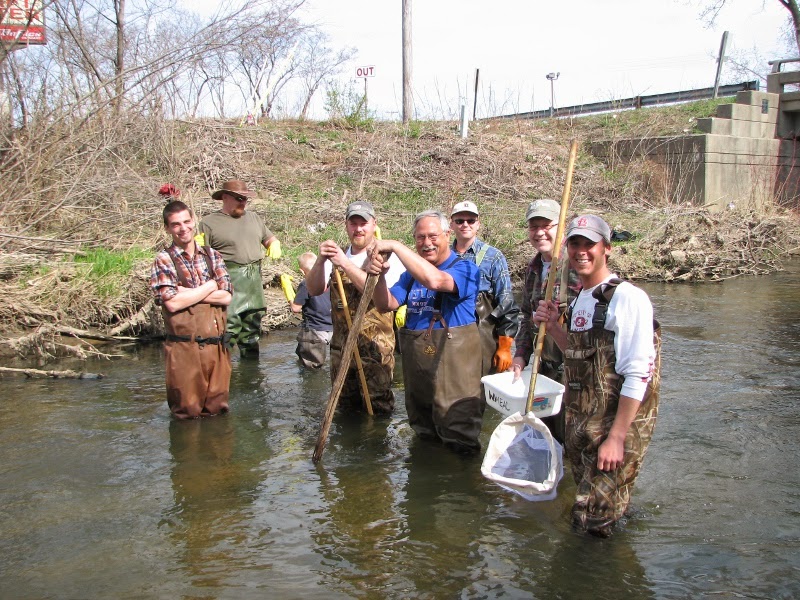
I have already hinted at the negative role that man can play in the life cycle of a stream as a prime polluter; yet people can, of course, be part of the cycle in positive ways too. But in order to do so, I believe they will have to spend some time in rivers observing the beauty of the life cycle and really understanding how it all works. One of the best ways to do this, I think, is by fly fishing. Unfortunately, I cannot say that I speak of this from a whole lot of personal experience (something I hope to change in the near future), but from what I do know, fly fishing puts you right in the water with the fish and other river life and forces you to take to time to observe what is going on around you while you quietly wait for the fish to grab your fly. And then when the fish finally does jump through the air and grab your fly, you realize that you yourself have become part of the life cycle of the river too, and it is a beautiful experience!

I believe spending time on rivers and seeing how life flourishes in the running water is something that would give me renewed life. In fact, I am thinking about how I might be able to spend several months exploring rivers as part of a pastoral sabbatical -- a sabbatical by which I, and also members of Trinity Church, can ourselves become better rivers of living water, for the benefit of all those we come in contact with in our cycle of life.
Tuesday, September 16, 2014
Little Woman, Huge Faith
We all live up to our beliefs. Truly, we live according to what we believe to be true. However, that which we profess to believe we rarely live up to. There is a huge difference in what we actually believe and that which we profess to believe.
In the story about the woman from Syrophoenicia recorded in Matthew 15:21-28, Jesus is addressing the true beliefs of his disciples regarding women and Gentiles. Though they might have been honest enough to confess their prejudices, Jesus is using a powerful teaching moment to expose their sinful attitudes. Let’s look carefully at how he does it.
I have often struggled with this passage because in it Jesus seems to be so harsh and cruel to a minority single mom who needs help for her daughter. You would think that Jesus would be very kind and compassionate to her, as he has been to others in the past. He healed the servant of a Centurion. He healed a demoniac on the other side of the Sea of Galilee. He raised the synagogue ruler’s daughter who had died. He had just said, “Come until me all who are weary and heavy laden and I will give you rest.” And then a single mom with a terribly sick daughter comes to him and he says and does nothing. This is not the Jesus I know. Why?

As I mentioned, Jesus is exposing the sexism and racism of his disciples. These ran deep in the culture in those days. There was a prayer which men often said which went like this: “Blessed are you Lord God for not making me a Gentile, a slave, or a woman.” This prayer was said every morning by devout men in Israel. Paul addresses this very prayer in his letter to Galatians when he says in 3:28, “There is neither Jew nor Greek, slave nor free, male nor female, for you are all one in Christ Jesus.” Even the order of the groups mentioned is exactly the same in the Jewish prayer and in Paul’s teaching against this statement.
Sexism was so rampant in Israel at the time of Jesus that a Rabbi would not speak to a woman in public, not even to his own family members. So when Jesus did not reply to this Syrophoenician woman it was out of his character to remain silent, but it would be the norm of how a rabbi would treat the situation. And unfortunately the disciples seem ok with that. In fact the disciples tell Jesus to send her away because she is annoying them.
Jesus then affirms their belief by saying that he was only sent to the lost sheep of Israel. But he has already healed Gentiles and their children. Why now does he say this? Well, he is engaging in something called reductio ad adserdem. This is when a person takes a position and shows its logical conclusion. This is something people like Gandhi and Martin Luther King were very good at doing.
But this woman is very insistent. She comes to Jesus again on her knees and begs him to help her.
Then, amazingly, Jesus replies with the most insensitive saying imaginable. He says that it is not right to take the children’s bread and give it to the little dogs. Now this is hard for me to listen to from the mouth of Jesus. Dogs were just a bit above pigs. They were despised. They were not domesticated or house pets. Jesus is using the term little dogs, but I don’t know if this is any better.
Hopefully the disciples at this time are hearing what their own views about women and Gentiles actually sound like. Jesus is illustrating in a graphic way what their own racism and sexism really look and sound like. He was using this special moment and his gift of teaching to rid them of their prejudices.
Jesus also used this special moment to heal the Syrophoenician woman’s daughter. Jesus blessed her because of her great faith.
Jesus had a great appreciation for the faith of women and elevated them whenever he could. He allowed a sinful woman to anoint his feet. He allowed Mary to hug him after his resurrection. He allowed Mary to sit at his feet and he taught her right along with the rest of his disciples. He was revolutionary when it came to his positive dealings with women, even those who were not Jewish.
The faith of this single minority mom was huge, and her daughter was healed. The disciples, on the other hand, learned an important lesson about how to treat women and minorities. This is a lesson we all need to learn.
We all live up to our beliefs. Truly, we live according to what we believe to be true. However, that which we profess to believe we rarely live up to. There is a huge difference in what we actually believe and that which we profess to believe.
In the story about the woman from Syrophoenicia recorded in Matthew 15:21-28, Jesus is addressing the true beliefs of his disciples regarding women and Gentiles. Though they might have been honest enough to confess their prejudices, Jesus is using a powerful teaching moment to expose their sinful attitudes. Let’s look carefully at how he does it.
I have often struggled with this passage because in it Jesus seems to be so harsh and cruel to a minority single mom who needs help for her daughter. You would think that Jesus would be very kind and compassionate to her, as he has been to others in the past. He healed the servant of a Centurion. He healed a demoniac on the other side of the Sea of Galilee. He raised the synagogue ruler’s daughter who had died. He had just said, “Come until me all who are weary and heavy laden and I will give you rest.” And then a single mom with a terribly sick daughter comes to him and he says and does nothing. This is not the Jesus I know. Why?
As I mentioned, Jesus is exposing the sexism and racism of his disciples. These ran deep in the culture in those days. There was a prayer which men often said which went like this: “Blessed are you Lord God for not making me a Gentile, a slave, or a woman.” This prayer was said every morning by devout men in Israel. Paul addresses this very prayer in his letter to Galatians when he says in 3:28, “There is neither Jew nor Greek, slave nor free, male nor female, for you are all one in Christ Jesus.” Even the order of the groups mentioned is exactly the same in the Jewish prayer and in Paul’s teaching against this statement.
Sexism was so rampant in Israel at the time of Jesus that a Rabbi would not speak to a woman in public, not even to his own family members. So when Jesus did not reply to this Syrophoenician woman it was out of his character to remain silent, but it would be the norm of how a rabbi would treat the situation. And unfortunately the disciples seem ok with that. In fact the disciples tell Jesus to send her away because she is annoying them.
Jesus then affirms their belief by saying that he was only sent to the lost sheep of Israel. But he has already healed Gentiles and their children. Why now does he say this? Well, he is engaging in something called reductio ad adserdem. This is when a person takes a position and shows its logical conclusion. This is something people like Gandhi and Martin Luther King were very good at doing.
But this woman is very insistent. She comes to Jesus again on her knees and begs him to help her.
Then, amazingly, Jesus replies with the most insensitive saying imaginable. He says that it is not right to take the children’s bread and give it to the little dogs. Now this is hard for me to listen to from the mouth of Jesus. Dogs were just a bit above pigs. They were despised. They were not domesticated or house pets. Jesus is using the term little dogs, but I don’t know if this is any better.
Hopefully the disciples at this time are hearing what their own views about women and Gentiles actually sound like. Jesus is illustrating in a graphic way what their own racism and sexism really look and sound like. He was using this special moment and his gift of teaching to rid them of their prejudices.
Jesus also used this special moment to heal the Syrophoenician woman’s daughter. Jesus blessed her because of her great faith.
Jesus had a great appreciation for the faith of women and elevated them whenever he could. He allowed a sinful woman to anoint his feet. He allowed Mary to hug him after his resurrection. He allowed Mary to sit at his feet and he taught her right along with the rest of his disciples. He was revolutionary when it came to his positive dealings with women, even those who were not Jewish.
The faith of this single minority mom was huge, and her daughter was healed. The disciples, on the other hand, learned an important lesson about how to treat women and minorities. This is a lesson we all need to learn.
Thursday, March 20, 2014
The Spirit Guides

The beauty of the Bible is that is always challenges us to look very carefully at what God is teaching us. During the months of January and February I have been learning a lot about the early church and how the church should function. The Spirit-filled church of Acts has so much to teach us in how we go about doing church. One area in which I am growing is in the area of understanding how the Holy Spirit leads us.
Ever since I went to a seminar on listening prayer at the beginning of January, I have been studying the book of Acts trying to find out how the Holy Spirit guided the early church and its leaders. I have combed through the entire book of Acts and looked at every instance of where individuals or groups have received divine guidance to see what principles and patterns I could find.
Overall, I found four predominant ways that the early church was guided to make decisions. The first way was in putting forth a proposal and discussing it together. The church leaders used this proposal and discussion method in at least three instances: in Acts 1, when they were looking for a replacement for Judas; in Acts 6, when they were choosing the seven men who would oversee the distribution of food to widows; and in Acts 15, where they were resolving differences over Gentile believers coming into the church.
The second frequently occurring way of finding guidance was through a vision. In Acts 9, Saul had a vision of Christ at his conversion and was instructed in what to do next. In Acts 10, both Cornelius, a God-fearing gentile, and the apostle Peter received complimentary instructions through visions. In Acts 16, Paul had his vision of the man calling for help from Macedonia. And then in Acts 18, Paul received a vision encouraging him to keep teaching in Corinth.
Thirdly, we find that angels were often sent to give guidance and protection to apostles in difficult or uncertain circumstances, such as imprisonment, storms at sea, and even Philip’s being sent to teach the Ethiopian eunuch. You can find these stories in Acts 5, 8, 12 and 27.
The fourth commonly occurring form of guidance was by the voice of the Holy Spirit being manifested in some way. This very often occurred when someone was to be sent to a new place or to do something new. For example, in Acts 13, Paul and Barnabas were sent on their missionary journey by the word of the Spirit. In Acts 20, Paul was compelled to go to Jerusalem by the Spirit. Then in Acts 21, Paul received a prophecy from the prophet Agabus, which was given by the Spirit. Peter also received a word from the Spirit, along with the vision, in Acts 10.
Having discovered all this, I can only come to one sure set of conclusions and that is this: the Holy Spirit guided the early church in a variety of ways depending on the people and the circumstances involved. The Spirit guided the early church even at times when it does not appear that they were looking for guidance. He guided by a certain method in one instance and in the next instance he lead in another way. Each person and each circumstance was different and the Holy Spirit knew what was needed.
We have to be careful that we do not put the Holy Spirit in a box and try to control the way that he speaks to us. However, it is so very important that we seek to have the mind of Christ. In 1 Corinthians 2:16 Paul concludes a discussion about knowing God’s will by saying, “But we have the mind of Christ.” Again in Romans 12:2 Paul teaches us, “Be transformed by the renewing of your mind. Then you will be able to test and approve what God’s will is – his good, pleasing and perfect will.”

Growing so close to Christ that we know his mind is so very helpful in knowing the will of God in situations that we encounter. To me it is like that old game show on TV called “The Newlyweds.” Remember how one of the couple was in a back room and they asked questions to the other spouse to see if they knew how the hidden spouse would answer. Then they got them back together and found out how close they might have come to knowing the mind of their spouses. Some couples knew each other so well that they almost always knew what the other one was thinking.
When we really mature in Christ and get to know the mind of Christ, we know what his will would be in more and more of the situations that we are faced with in life. Finding God’s will does not have to be a difficult thing as we begin to simply know the will of the Lord because we understand the mind of Christ. This is what we should all be seeking in our lives -- renewing our minds to know the will of God.
Monday, December 16, 2013
Glory in the End
Have you ever imagined how your own death will come about? Now I know this might seem macabre, but I would imagine most people have thought about it. I can remember in grade school, in Minnesota, in the depth of winter, our class read, “To Build a Fire” by Jack London. It is the story of a man in the Yukon who freezes to death walking to his friend’s cabin. Ever since that time I have thought that freezing to death would be the worst way to die.

Interestingly, there is a short section in the Gospel of John which talks about the subject of dying. Jesus has prepared a breakfast of fish for his disciples and begins to ask Peter if he loves him more than anything. Peter responds three times that he does. Then, after the third expression of love, Jesus says to Peter, “I tell you the truth, when you were younger you dressed yourself and went where you wanted; but when you are old you will stretch out you hands, and someone else will dress you and lead you where you do not want to go.” Then John adds, “Jesus said this to indicate the kind of death by which Peter would glorify God.”
What was Jesus telling Peter here? This passage has often been used to indicate that Peter was crucified. And this could be what it means because the word used for “get dressed” means ‘tie up a belt,” which in those days would be a rope. In the days of the Romans, being tied up probably meant you were a prisoner and possibly were going to be crucified. The other expression, “stretch out you hands,” was often used to describe crucifixion. Though we cannot be certain, Jesus may have been informing Peter that he probably would suffer at the end of his life and that this suffering would lead to his death.
But this passage could also simply mean that when a person is younger he is able to do as he pleases and go where he wants to go and take care of himself. But when he gets older and closer to death, others will care for him, dress him and take him places where he does not want to go. The aging process always ends in death and Jesus was telling Peter that he would live to be old, but even in dying in weakness and blindness he was still going to glorify God.
I am sure Jesus had Peter thinking. He probably thought that he was fortunate that he would live to be old. But he also knew that he was going to die in weakness and even through that weakness he was going to be able to glorify God. I wonder if we think about how our death will glorify God. And what would make a God-glorifying death?
I believe what Jesus was looking for from Peter was a life lived in complete service to him. That Peter would be faithful to the very end of his life and that even in the face of sickness, blindness, captivity, suffering or whatever might come his way, he would not complain but simply graciously thank the Lord for his gift of grace. Jesus was looking for Peter to live as Paul would later write in Romans 8:18, “I consider that our present sufferings are not worth comparing with the glory that will be revealed in us.”
I do not know how I will die, though I still hope I do not freeze to death, but I trust that I will be faithfully serving the Lord with every ounce of strength he gives me to the very end. And if that means suffering, then may I glorify Christ in my suffering as well.

Interestingly, there is a short section in the Gospel of John which talks about the subject of dying. Jesus has prepared a breakfast of fish for his disciples and begins to ask Peter if he loves him more than anything. Peter responds three times that he does. Then, after the third expression of love, Jesus says to Peter, “I tell you the truth, when you were younger you dressed yourself and went where you wanted; but when you are old you will stretch out you hands, and someone else will dress you and lead you where you do not want to go.” Then John adds, “Jesus said this to indicate the kind of death by which Peter would glorify God.”
What was Jesus telling Peter here? This passage has often been used to indicate that Peter was crucified. And this could be what it means because the word used for “get dressed” means ‘tie up a belt,” which in those days would be a rope. In the days of the Romans, being tied up probably meant you were a prisoner and possibly were going to be crucified. The other expression, “stretch out you hands,” was often used to describe crucifixion. Though we cannot be certain, Jesus may have been informing Peter that he probably would suffer at the end of his life and that this suffering would lead to his death.
But this passage could also simply mean that when a person is younger he is able to do as he pleases and go where he wants to go and take care of himself. But when he gets older and closer to death, others will care for him, dress him and take him places where he does not want to go. The aging process always ends in death and Jesus was telling Peter that he would live to be old, but even in dying in weakness and blindness he was still going to glorify God.
I am sure Jesus had Peter thinking. He probably thought that he was fortunate that he would live to be old. But he also knew that he was going to die in weakness and even through that weakness he was going to be able to glorify God. I wonder if we think about how our death will glorify God. And what would make a God-glorifying death?
I believe what Jesus was looking for from Peter was a life lived in complete service to him. That Peter would be faithful to the very end of his life and that even in the face of sickness, blindness, captivity, suffering or whatever might come his way, he would not complain but simply graciously thank the Lord for his gift of grace. Jesus was looking for Peter to live as Paul would later write in Romans 8:18, “I consider that our present sufferings are not worth comparing with the glory that will be revealed in us.”
I do not know how I will die, though I still hope I do not freeze to death, but I trust that I will be faithfully serving the Lord with every ounce of strength he gives me to the very end. And if that means suffering, then may I glorify Christ in my suffering as well.
Monday, September 24, 2012
A Bride for God
One of the greatest wonders in the world is falling in love with somebody. This is unbelievably special and changes one’s entire life. It is one of those inexplicable mysteries of the world. This is especially true when you consider God falling in love with His people. Moses puts it very succinctly in Deuteronomy 7, “The Lord did not set his affection on you and choose you because you were more numerous than other peoples, for you were the fewest of all peoples. But it was because the Lord loved you and kept the oath he swore to your ancestors that he brought you out with a mighty hand and redeemed you from the land of slavery, from the power of Pharaoh king of Egypt.”
It was the pure and mysterious love of God that caused Him to embrace the people of Israel and bring them out of Egypt. He took them first to Mt. Sinai, where a covenant was made between them. It was oh so similar to a Jewish wedding, even today. God and his people stood under a hupah (cloud) to say their vows. God promised to love, protect and provide for his bride, and His bride was to promise to be forever faithful.
What a shock then that before the ceremony is even finished Israel has created another god—a golden calf! The idea for a calf was not original at all. Hathor, the goddess of fertility and consort of Ra, was well known in Egypt, having many temples dedicated to her. She is the calf-god of Egypt. It was almost as if the people took themselves out of the marriage ceremony and placed Hathor in their place. But God wanted to wed a people made in His image, not an idol that is unable to love.

Unfortunately, the situation did not change much as God’s bride entered into Canaan. Here they were presented with Asherah, the fertility goddess of the Canaanites. She is said to have been the consort of the god Baal. She is depicted as a pole with the figure of a woman and is placed next to the altar of Baal in the pagan temples and high places. This summer we visited a high place. There we saw the altar for sacrifices made to their god, and right next to it was a platform that would quite possibly be used for the image of the god’s consort.

In a terrible offence to the God who loves and cares for His people, Israel continued to substitute their position as God’s bride with an idol which was incapable of affection. Even the evil king Manasseh made an Asherah pole and placed it in the Temple, probably next to the altar of God.
But God is not interested in dating a pole! He is looking for living, loving people. And though we are COMPLETELY unworthy of being His, he loves us and gave his Son for us. Now we are the bride of Christ. Could there be anything greater?! So let’s get rid of any and every thing that would keep us from placing all of our affection on the One who loves, protects, provides, and even died for us.
It was the pure and mysterious love of God that caused Him to embrace the people of Israel and bring them out of Egypt. He took them first to Mt. Sinai, where a covenant was made between them. It was oh so similar to a Jewish wedding, even today. God and his people stood under a hupah (cloud) to say their vows. God promised to love, protect and provide for his bride, and His bride was to promise to be forever faithful.
What a shock then that before the ceremony is even finished Israel has created another god—a golden calf! The idea for a calf was not original at all. Hathor, the goddess of fertility and consort of Ra, was well known in Egypt, having many temples dedicated to her. She is the calf-god of Egypt. It was almost as if the people took themselves out of the marriage ceremony and placed Hathor in their place. But God wanted to wed a people made in His image, not an idol that is unable to love.
Unfortunately, the situation did not change much as God’s bride entered into Canaan. Here they were presented with Asherah, the fertility goddess of the Canaanites. She is said to have been the consort of the god Baal. She is depicted as a pole with the figure of a woman and is placed next to the altar of Baal in the pagan temples and high places. This summer we visited a high place. There we saw the altar for sacrifices made to their god, and right next to it was a platform that would quite possibly be used for the image of the god’s consort.
In a terrible offence to the God who loves and cares for His people, Israel continued to substitute their position as God’s bride with an idol which was incapable of affection. Even the evil king Manasseh made an Asherah pole and placed it in the Temple, probably next to the altar of God.
But God is not interested in dating a pole! He is looking for living, loving people. And though we are COMPLETELY unworthy of being His, he loves us and gave his Son for us. Now we are the bride of Christ. Could there be anything greater?! So let’s get rid of any and every thing that would keep us from placing all of our affection on the One who loves, protects, provides, and even died for us.
Friday, September 7, 2012
Living Water
One amazing thing about our trip to the Middle East was that we traveled through several deserts—the Sahara, Sinai, Negev, Judean, and Arabian. But at the same time, we swam or waded in some wonderful waters—the Nile River, Red Sea, Gulf of Aquaba, Dead Sea, Arnon River, Ein Gedi, Jordan River, Sea of Galilee, and Mediterranean Sea. I think the favorite dunking I took was in the Arnon River. Hiking up the river gorge in the river was challenging and refreshing at the same time. Working together we were able to climb over huge rocks, slippery boulders, and negotiate water falls. Everybody made it to the 30 foot water falls which stopped our progress up the gorge. However, we all were able to squeeze into a cave behind the water falls where Pastor George talked to us about the overwhelming love of God, like the water that was plunging over us.

We also learned about the difference between living water and water that comes from a cistern. Living water is water that is clean, cool and refreshing. It is running water and a great thirst quencher. Cistern water might be ok for bathing, but is not the best for drinking. It probably has some microbes in it that you would not want in your body, and it is not that refreshing.

The source of the Jordan River is living water. It runs out of several springs at the base of Mt. Hermon. It is cool, clear and very refreshing. It also gives life to everything around its banks. There are abundant plants and an amazing amount of birds that make the upper Jordan River their home.

We also got to walk Hezekiah’s tunnel, which he built in about 700 BC to secure the water supply to the old city of Jerusalem. He tunneled 1,700 feet from the Gehon spring to the pool of Siloam. Today you can walk this tunnel as cool water rushes around your knees.

This is all simply background for the time that Jesus was in the temple on the last day of the Feast of Tabernacles. Just when the priests would have taken some clean, fresh water from the pool of Siloam and poured it around the altar in the temple, Jesus says in John 7:37 & 38, “Let anyone who is thirsty come to me and drink. Whoever believes in me, as Scripture has said, rivers of living water will flow from within them.”
As believers in Jesus, we are the ones who should be gushing living water everywhere we go. There should be life springing up all around us because of the living water flowing from us. So just a simple question: do we bring life to people, do we help people come alive in Christ? I really hope we who believe in Jesus are life givers.
We also learned about the difference between living water and water that comes from a cistern. Living water is water that is clean, cool and refreshing. It is running water and a great thirst quencher. Cistern water might be ok for bathing, but is not the best for drinking. It probably has some microbes in it that you would not want in your body, and it is not that refreshing.
The source of the Jordan River is living water. It runs out of several springs at the base of Mt. Hermon. It is cool, clear and very refreshing. It also gives life to everything around its banks. There are abundant plants and an amazing amount of birds that make the upper Jordan River their home.
We also got to walk Hezekiah’s tunnel, which he built in about 700 BC to secure the water supply to the old city of Jerusalem. He tunneled 1,700 feet from the Gehon spring to the pool of Siloam. Today you can walk this tunnel as cool water rushes around your knees.
This is all simply background for the time that Jesus was in the temple on the last day of the Feast of Tabernacles. Just when the priests would have taken some clean, fresh water from the pool of Siloam and poured it around the altar in the temple, Jesus says in John 7:37 & 38, “Let anyone who is thirsty come to me and drink. Whoever believes in me, as Scripture has said, rivers of living water will flow from within them.”
As believers in Jesus, we are the ones who should be gushing living water everywhere we go. There should be life springing up all around us because of the living water flowing from us. So just a simple question: do we bring life to people, do we help people come alive in Christ? I really hope we who believe in Jesus are life givers.
Thursday, August 30, 2012
Finding our Refuge in God
Finding our Refuge in the Lord
It seems like there is an abundance of caves in the Holy Land. Or you might say that the Holy Land is very holey. David found out that these caves were the place where he could hind from King Saul when he became jealous of David’s success as a warrior. It was probably in the of the caves of Adullam that David wrote the beautiful words of Psalm 142. In it he says, “Look and see, there is no one at my right hand; no one is concerned for me. I have no refuge; no one cares for my life. I cry to you, Lord; I say, ‘You are my refuge, my portion in the land of the living’.”

There in the darkness of the cave the Lord heard his plea and saved him, not by destroying Saul, but by bringing people around him. His family came and soon many others came to live with him in the caves. Before long 400 rabble rousers joined him and became his protection. God brought people who were distress, in debt and discontented to David and he became their leader—a veritable Old Testament Robin Hood.
When David needed another hiding place he found the caves of Ein Gedi to be just the place. Saul again was searching him out when unknowingly he ventured into a cave to releave himself where David and some of him men were hiding. Without Saul knowing, David found where Saul had taken off his robe and then cut the corner off it. After Saul was finished and out of the cave David went to him, bowed down before him with the corner of his robe in his hand. He told Saul how he could have killed him but did not because he was God’s anointed. Saul then had a change of heart and acknowledged that David would indeed be the king of Israel.

I would have to think that David learned many life lessons in the caves of the Judean hills. He learned that even though the caves provided protection, it was really the Lord who was his refuge. And the Lord provided him a community to care and protect him.

Where do we find our refuge? I have a suspicion that we find refuge in being able to control our circumstances and have power over any situation. But if we simply seek out of refuge in the Lord who is in control of all circumstance and has all authority over every situation, we can rest at peace no matter where we lay our heads down to rest.
It seems like there is an abundance of caves in the Holy Land. Or you might say that the Holy Land is very holey. David found out that these caves were the place where he could hind from King Saul when he became jealous of David’s success as a warrior. It was probably in the of the caves of Adullam that David wrote the beautiful words of Psalm 142. In it he says, “Look and see, there is no one at my right hand; no one is concerned for me. I have no refuge; no one cares for my life. I cry to you, Lord; I say, ‘You are my refuge, my portion in the land of the living’.”
There in the darkness of the cave the Lord heard his plea and saved him, not by destroying Saul, but by bringing people around him. His family came and soon many others came to live with him in the caves. Before long 400 rabble rousers joined him and became his protection. God brought people who were distress, in debt and discontented to David and he became their leader—a veritable Old Testament Robin Hood.
When David needed another hiding place he found the caves of Ein Gedi to be just the place. Saul again was searching him out when unknowingly he ventured into a cave to releave himself where David and some of him men were hiding. Without Saul knowing, David found where Saul had taken off his robe and then cut the corner off it. After Saul was finished and out of the cave David went to him, bowed down before him with the corner of his robe in his hand. He told Saul how he could have killed him but did not because he was God’s anointed. Saul then had a change of heart and acknowledged that David would indeed be the king of Israel.
I would have to think that David learned many life lessons in the caves of the Judean hills. He learned that even though the caves provided protection, it was really the Lord who was his refuge. And the Lord provided him a community to care and protect him.
Where do we find our refuge? I have a suspicion that we find refuge in being able to control our circumstances and have power over any situation. But if we simply seek out of refuge in the Lord who is in control of all circumstance and has all authority over every situation, we can rest at peace no matter where we lay our heads down to rest.
Monday, August 27, 2012
The Heart of God
Often when we read the stories about the people of Israel leaving Egypt and traveling into the Promised Land, we have to swallow hard when we come to the fight scenes. We ask, “Why did God tell the Israelites to kill so many people?” It seems so cold, and not something the God of the New Testament would do. It is certainly not Jesus’ style.
But before we begin to chisel away at the reputation of the God of the Old Testament, we should take a good look at what God is doing in bringing his people from Egypt to Israel and how He does it.
Take the story of the Amalekites. God took his people out of Egypt and away from any populations that could attack them. He did not want his people to go to war. However, the Amalekites followed them on their journey down the Sinai Peninsula. There they attacked the Israelites who fell behind—those who were old, weak, or disabled. Finally, at Rephedim, God told his people to fight the Amalekites. This was in response to the terrible things they did, the killing of the old, weak and disabled. This is simply evil and God would not just sit back and do nothing while those who needed the most help were slaughtered by a people who preyed on those who lagged behind.
I hope you see in this the heart of God – a God who desires peace, yet who will not let the weak be destroyed by evil. I wonder how closely our hearts resemble this heart of God when it comes to defending the weak and those who “lag behind.” Do we care for and stand up for the disabled, the elderly and even the unborn? Do we take on another’s burdens and share them? Do we follow the example of our Saviour, who was so desirous that God’s people not suffer that he took the evil of the world onto himself and defeated it with love and forgiveness? This now should be our modus operandi– to “overcome evil with good.”
But before we begin to chisel away at the reputation of the God of the Old Testament, we should take a good look at what God is doing in bringing his people from Egypt to Israel and how He does it.
Take the story of the Amalekites. God took his people out of Egypt and away from any populations that could attack them. He did not want his people to go to war. However, the Amalekites followed them on their journey down the Sinai Peninsula. There they attacked the Israelites who fell behind—those who were old, weak, or disabled. Finally, at Rephedim, God told his people to fight the Amalekites. This was in response to the terrible things they did, the killing of the old, weak and disabled. This is simply evil and God would not just sit back and do nothing while those who needed the most help were slaughtered by a people who preyed on those who lagged behind.
 |
| The Valley of Rephidim -- Amalekites defeated |
Friday, August 17, 2012
Aliyah!
When Laura and I signed up for a trip to Egypt, Jordan and Israel we understood that we were going to have to hike and hike hard up several mountains. We knew that the biggest hike was going to be up Mt. Sinai, or technically, Mt. St. Catherine. So we began to prepare ourselves for what we knew would be a four hour climb up about 4,000 feet to the summit. Laura ran stairs and walked hard. I ran several 5Ks and a 10K before we left. We also went for long hikes together every Friday for several weeks leading up to our departure. It was a real challenge and a good deal of work getting ready for our trip. We did not want to fail at climbing Mt. Sinai.
Our trip up Mt. St. Catherine started after a long bus ride from the Red Sea. It was not until about three in the afternoon that we started up the mountain. The first hour we traveled on camel back -- interesting but not real comfortable. Then we got off and began the real hike up, and up, and up. The trail was well-marked but steep, with many switch backs zigzagging up a rocky face.


We were still an hour from the top when the sun set and the world became dark. Then, climbing with our flashlights, we arrived at the top where some Bedouins had a fire and dinner waiting for us -- tea, soup, roast quail, rice and melons. We put on a base layer, rolled out sleeping pads, and pulled heavy wool blankets over us to sleep under the stillness of the billions of stars.


What kept us going up and up was a Hebrew word that Pastor George taught us: aliyah. It is a great word which means “to go up” or “to ascend.” It is used frequently in the Old Testament to describe how people went up to meet the Lord. It is used of Moses when he climbed Mt. Sinai. The Exodus narrative tells us that Moses “went up” to the Lord at least four times. God could have easily met him at a lower elevation. He could have even come down into the valley. But he told Moses to come up to the top of Mt. Sinai. What a tremendous effort God expected of Moses to meet with Him and come to know Him.
Today we rarely expend any effort to meet with God. Instead we look for convenience and comfort in our meeting with the Lord. Simply attending church takes minimal effort. We often fit our life of devotion to God into our lives when it works for us -- driving down the road, or a quick prayer before a meal. When do we really go up, or aliyah, to meet with the Lord? It makes me wonder, do I really put any effort into my relationship with God? I am really trying to take the effort that I put into getting physically prepared to hike up Mt. Sinai into getting spiritually prepared for all the mountains the Lord will have me climb during the rest of my life.
Our trip up Mt. St. Catherine started after a long bus ride from the Red Sea. It was not until about three in the afternoon that we started up the mountain. The first hour we traveled on camel back -- interesting but not real comfortable. Then we got off and began the real hike up, and up, and up. The trail was well-marked but steep, with many switch backs zigzagging up a rocky face.
We were still an hour from the top when the sun set and the world became dark. Then, climbing with our flashlights, we arrived at the top where some Bedouins had a fire and dinner waiting for us -- tea, soup, roast quail, rice and melons. We put on a base layer, rolled out sleeping pads, and pulled heavy wool blankets over us to sleep under the stillness of the billions of stars.
What kept us going up and up was a Hebrew word that Pastor George taught us: aliyah. It is a great word which means “to go up” or “to ascend.” It is used frequently in the Old Testament to describe how people went up to meet the Lord. It is used of Moses when he climbed Mt. Sinai. The Exodus narrative tells us that Moses “went up” to the Lord at least four times. God could have easily met him at a lower elevation. He could have even come down into the valley. But he told Moses to come up to the top of Mt. Sinai. What a tremendous effort God expected of Moses to meet with Him and come to know Him.
Today we rarely expend any effort to meet with God. Instead we look for convenience and comfort in our meeting with the Lord. Simply attending church takes minimal effort. We often fit our life of devotion to God into our lives when it works for us -- driving down the road, or a quick prayer before a meal. When do we really go up, or aliyah, to meet with the Lord? It makes me wonder, do I really put any effort into my relationship with God? I am really trying to take the effort that I put into getting physically prepared to hike up Mt. Sinai into getting spiritually prepared for all the mountains the Lord will have me climb during the rest of my life.
Subscribe to:
Posts (Atom)
