Showing posts with label Creation Care. Show all posts

Wednesday, December 6, 2017

Rivers Bring Life

The Father, Son and Holy Spirit created life.  And then, they began to spread life everywhere.  God the Father created the heavens and the earth.  He did so through God the Son, as the book of Colossians says: “For by him (Jesus Christ) all things were created: things in heaven and on earth.”  But the Holy Spirit is also active in the creation of the world, as Genesis tells us when it says, “and the Spirit of God was hovering over the waters.”  The Triune God loves life, and let me tell you, I do too!  And I just love the way that this Triune God bring us life.


The focus of waters right from the beginning gives us an indication of the way that God was going to use water as that which brings us life. Genesis 2:10-14 says, “A river watering the garden flowed from Eden; from there it was separated into four headwaters. The name of the first is the Pishon; it winds through the entire land of Havilah, where there is gold. (The gold of that land is good; aromatic resin and onyx are also there.) The name of the second river is the Gihon; it winds through the entire land of Cush. The name of the third river is the Tigris; it runs along the east side of Ashur. And the fourth river is the Euphrates.”

The river flowing from Eden gives life to all that God has created.  The river separates into four headwaters which signify the four corners of the world as the ancients understood it.  God simply used four rivers to bring life to the entire creation.  From the beginning, water was life.  And water is best delivered by way of a river. 

Later, in a seemingly hopeless time for God’s people, the prophet Ezekiel was given a vision of a river flowing from the altar in the Temple.  Though it started very small it was soon a great river with many trees growing on the banks.  The river flowed into the Salt Sea and there everything turned sweet with swarms of living creatures everywhere.  People were fishing on the banks of what once was a barren body of water.  This is a great picture of a river giving life to flora, fauna and folks everywhere.  Don’t we just long for the vision of Ezekiel to become a reality in our lives?

Ezekiel’s vision is repeated in the last book of the Bible.  In the last chapter of Revelation, when heaven has come down to earth and eternity is about to begin, we see a river of the water of life flowing from the throne of God.  As it flows there are trees that line the river producing fruit every month of the year.  The leaves of those trees are for healing the brokenness of the world.  So once again, as in the beginning, the river is the way that God brings life to the New Heavens and the New Earth.

Right in the middle of these beautiful images of rivers giving life to all God has created, Jesus takes this image several notches higher.  In John 7:37-39 it says, “On the last and greatest day of the festival, Jesus stood and said in a loud voice, ‘Let anyone who is thirsty come to me and drink.  Whoever believes in me, as Scripture has said, rivers of living water will flow from within them.’ By this he meant the Spirit, whom those who believed in him were later to receive. Up to that time the Spirit had not been given, since Jesus had not yet been glorified.”  Jesus is the ultimate life giver, but with this unbelievable promise he tells us that all who drink of him will become rivers of life-giving water.  Imagine that; out of me and you there will be a river of life wherever we go!

I so want that to be true of me.  I long to be a river of life flowing all over the place, giving life to whomever wades into my waters.  This is also why I find caring for rivers and streams so very important, especially in the context of a church ministry.  Rivers bring life to all the creation.  The church is called to bring life to all creation.  And when we can combine the two in a visible way that helps the world see how much we value bringing life to creation, that is truly a beautiful thing, and something that gets the attention and appreciation of our community.

Rivers are essential for our environment so we need to care for them.   It does not matter if they are the mighty Mississippi or little Rush Creek.  But whether we are restoring badly degraded waterways or simply appreciating the life they give, each one of us is called to be a river of life spreading God’s life in some way wherever we go.  Are we doing it?

Wednesday, January 21, 2015

The River of Life

“We must begin thinking like a river if we are to leave a legacy of beauty and life for future generations.” ― David Brower

Genesis 2:10 says that “A river watering the garden flowed from Eden; from there it was separated into four headwaters.” God was the source of the river which gave life to all of creation.

Revelation 22:1 reads, “Then the angel showed me the river of the water of life, as clear as crystal, flowing from the throne of God and of the Lamb down the middle of the great street of the city.  On each side of the river stood the tree of life bearing twelve crops of fruit, yielding its fruit every month.  And the leaves of the tree are for the healing of the nations.”  The Bible concludes with a picture of another river flowing from God, who is its source, down the middle of the community and which gives life and healing to all.

And in between the first book and the last book of the Bible there are numerous other references to rivers and water. In Psalm 46:4 we read of a river whose streams make glad the city of God.  In Isaiah 41:18 God speaks of making rivers to flow on barren heights and of turning deserts into pools of water.  In Ezekiel 47 we get a very beautiful and detailed description of a great and mighty river flowing from the Temple of God that contains swarms of fish and other living creatures and that provides a sanctuary for fruit trees of all kinds to grow -- fruit trees which provide a continual  source of fruit for food and of leaves for healing. The references to rivers and water is perhaps climaxed in the words of Jesus Christ when he says to the woman at the well, “If you knew the gift of God and who it is that asks you for a drink, you would have asked him and he would have given you living water.” Living water is generally  understood to be running water because it is clear and clean and drinkable, while stagnant water is stale, dirty and impure. Clear, running water is a symbol of life --  life for our bodies and our souls.


Water has always fascinated and inspired me and I would love to be able to really explore in-depth the importance of rivers as a source of life -- life for our local ecosystems, health for our environment, and renewed life for us as stewards of God’s creation. Particularly important to me is understanding and even participating in the cycle of life that is found in rivers and streams. The Trinity Stream Team's work in Rush Creek these past several years has already taught me a lot about how the life cycle of a stream works.  I know that a healthy stream must have a good population of invertebrates. Invertebrates affect the nutrients of a stream by consuming and transforming various organic matter. They also are a food source for fish that inhabit the stream.  One thing the invertebrates are dependent upon is plant life in and around the stream. So a stream that is polluted and full of chemicals that kill or diminish plant life will not support a healthy invertebrate population and thus will also not be a good habitat for fish. This in turn means the stream will not be a good habitat for animals and other wildlife that are looking for fish to eat. 


I have already hinted at the negative role that man can play in the life cycle of a stream as a prime polluter; yet people can, of course, be part of the cycle in positive ways too.  But in order to do so, I believe they will have to spend some time in rivers observing the beauty of the life cycle and really understanding how it all works.  One of the best ways to do this, I think, is by fly fishing. Unfortunately, I cannot say that I speak of this from a whole lot of personal experience (something I hope to change in the near future), but from what I do know, fly fishing puts you right in the water with the fish and other river life and forces you to take to time to observe what is going on around you while you quietly wait for the fish to grab your fly.  And then when the fish finally does jump through the air and grab your fly, you realize that you yourself have become part of the life cycle of the river too, and it is a beautiful experience!


I believe spending time on rivers and seeing how life flourishes in the running water is something that would give me renewed life. In fact, I am thinking about how I might be able to spend several months exploring rivers as part of a pastoral sabbatical -- a sabbatical by which I, and also members of Trinity Church, can ourselves become better rivers of living water, for the benefit of all those we come in contact with in our cycle of life.


Wednesday, September 2, 2009

The Gift of Gardens

When you start reading the Bible it does not take very long until God makes a garden and tells Adam and Eve to starting tending it. Even before God had placed a curse on the ground they were working the soil. Maybe, that is why some still think that gardening is an divine vocation.

I know that I enjoy gardening along with a growing number of people. There might even be more people who would enjoy getting dirt under their fingernails if they only had a place to do that. So with this in mind, Trinity Church started a community garden on our property. It is in a lovely spot across a small creek from the church building in large section of green grass and trees. The garden, called "Seeds of Friendship Community Garden", has 16 plots which are 12 feet by 16 feet. People from our neighborhood and some folks from our church have been watching with joy the phenomenal growth in our little green space.


We have watched the radishes, carrots, potatoes, tomatoes, cabbage, watermelon, onions, peas and a cornucopia of other fruits and vegetables go crazy with life. We have also combined forces in defending our produce from the various insects that would love to consume it before we get a chance to. We have experimented with some very different organic pest controls in an effort to protect our produce.

We even added the incentive of a tallest sunflower contest. We have some beauties that must be over 10 feet tall!

I have been picking some of my produce and I thought I would just show you what can be done with just a little space and a little work. I love to eat the peas, the great potatoes and especially the small long white onions.


Tending a garden is a wonderful way to provide some wholesome food for your family and relax and enjoy the beauty and awesome mystery that God has placed in the tiniest seeds that grow to be sunflowers or friendships.

Please, make a garden to tend and enjoy the life that it brings to you.

Monday, June 15, 2009

The Garbage Runs In It

Hal Boyle once wrote: “What makes a river so restful to people is that it doesn't have any doubt - it is sure to get where it is going, and it doesn't want to go anywhere else.” What a splendid way to pass some time, sitting by a fresh stream and getting a sense of peace from the flowing waters. Why then do some folks want to flood the peaceful waters with tons of trash? The serenity of the stream is lost when a beer can or a chunk of Styrofoam comes floating by. Why is it so easy for some to dump their garbage into waters that flow? I wonder if there is some universal idea that the waters will wash the trash away. Perhaps it is not thoughtlessness that leads people to pour their garbage into running water, but rather an unspoken idea that once in the water it is gone.

Water is the great natural cleaner after all. Who would ever think of taking a shower in anything but water? Water is the perfect solvent. So why not let the river clean up our messes? The trouble is that what was once our mess now becomes the mess of somebody else living just a bit further downstream. Though water is a great symbol of our sins being washed away, it does not work for garbage. The garbage does not simply disappear; it will be an eye sore for many years to come. So what can we do make sure that the streams God has given us keep reminding us of him. We simply need to stop putting our trash in the water and then we should get into the water and clean it up.


This is what our Stream Team did this past Saturday, June 13. We put a canoe in Rush Creek and in less than a half mile we had so much junk in the canoe that we had to finish our trip downstream without picking up any thing else. We picked up lots of Styrofoam, plastic cups, bottles and buckets, even somebody’s living room carpet. We had to leave a tractor tire in the creek as we could not even lift up onto the canoe. It is nice to think that we got about a half mile of the creek cleaned up, but we hope to finish a two mile section by October. Just wait, we’ll get it done. There is sense of accomplishment in cleaning up a stream. Somehow it makes sitting on the bank and watching it flow a little more peaceful.

Tuesday, April 21, 2009

Stream Team

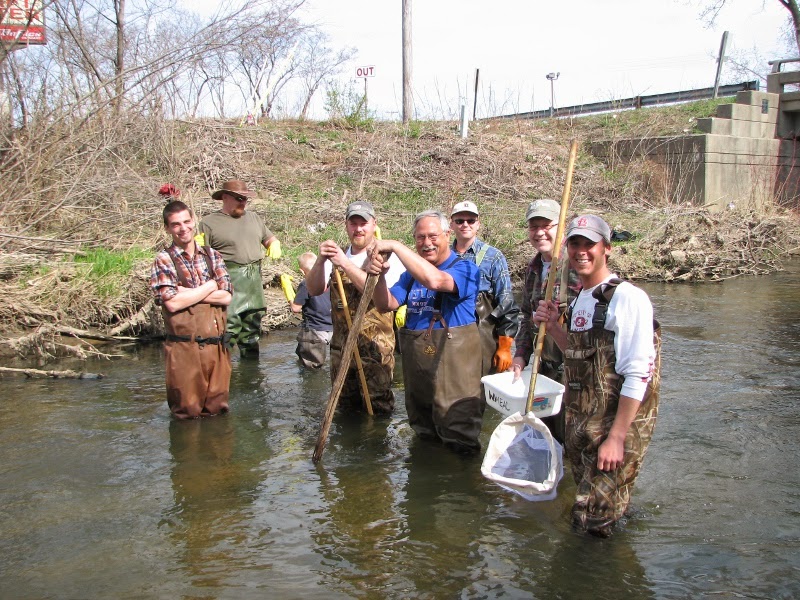
Here at Trinity Church we have put together a Stream Team. We are not the kind of team that shags flies, but the kind that catches bugs and other invertebrates from the bottom of a stream. We have partnered with the West Michigan Environmental Action Council (WMEAC) to monitor the lower end of Rush Creek. Rush Creek is a part of the lower Grand River Water Shed which the Michigan Department of Environmental Quality wants to carefully monitor. However, state funds are quite limited for these types of projects right now so we thought that we could provide the personnel that are needed to do the job. We also feel that we have been called to be good stewards of God's Creation and want to get more involved in making sure that our local water shed is healthy and clean.

Kristi Klomp, Water Quality Programs Coordinator at WMEAC, came to Trinity at 9:00 Saturday morning and set up a classroom. For the first hour she showed us a power point which described the invertebrates that we would be looking for. Then we pulled on our waders and headed to Rush Creek which runs just a block west of our church. Once in the stream Kristi taught us how to catch the critters we were looking for by disturbing the stream bed in front of our nets. We emptied the contents of the nets into wash tubs and gave them to members of the Stream Team that were waiting on the bank. They would carefully go through the contents and sort out all of the invertebrates that they could find. They would take the different invertebrates and put them in separate sections of an ice cube tray so that they could easily be counted.


We continued up stream collecting samples for 100 yards. We found Caddisflies, Stoneflies and Mayflies. There were also leaches, snails, clams and even a dragon fly larvae. We were all amazed at how much life there is on the bottom of Rush Creek.

There is a theological document called the Belgic Confession, written about 500 years ago, which says that every animal is a letter of God's creation alphabet which tells us of God's nature. Maybe the insects we found are not the capitals of the alphabet, but they still give you a glimpse of God. Each letter in the ice cube tray is certainly worth preserving so that we can continue to discover God under every rock we might turn over. Our Stream Team is trying to make sure Rush Creek keeps teaching us about God and his creation.

Thursday, April 16, 2009

Compost Barrel

In an effort to be a bit more eco-friendly around our house I have come up with a barrel composter to convert our organic waste into something quite useful. We hope to take our kitchen waste, lawn clippings, leaves and other organic material and fill up our barrel. Then after it "cooks" for a few weeks, empty it out and start over again. In this way we hope to not have to use a local yard waste service and be able to put out less trash on the curb.

The composter is really simple to make. It took just one plastic barrel, one 8 ft. 2x4 and one 8ft. 2x6, a 26" steel pipe and one 38" 2.5" PVC pipe. I ran the PVC pipe through the length of the barrel and it sticks out of both the top and bottom. The PVC is filled with 3/8 " holes so that there will be plenty of air movement through the barrel to help composting. I drilled several holes around the top and the bottom of the barrel for more air movement. The steel pipe runs right through the middle of the barrel and sits on a cradle I made out of wood. It is easy to rotate the barrel to mix up the material inside. I'm sure it will do what it is supposed to do, but I'll have to wait and see just how good it works. I'll make sure that I keep everybody com-posted. It's fun being green. -Gerry